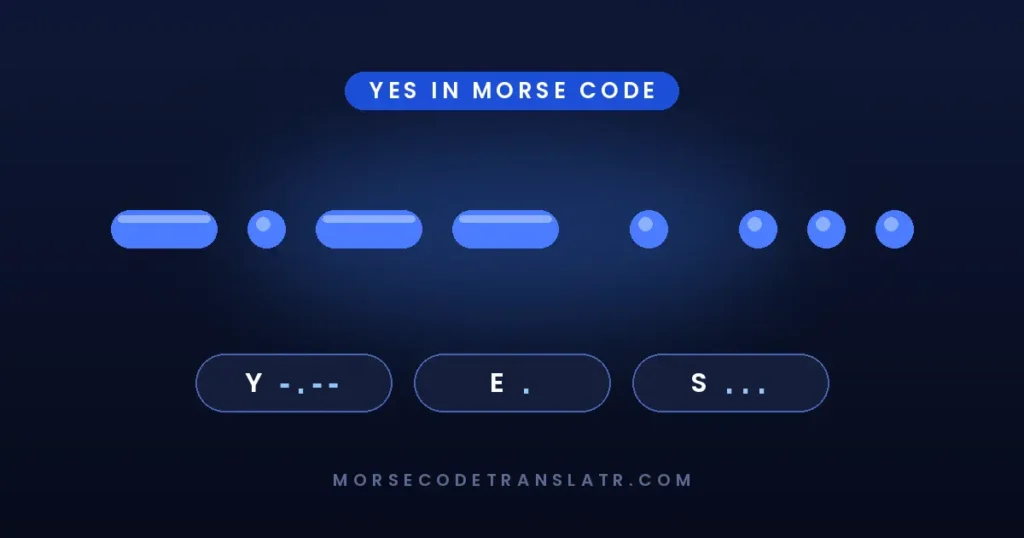
Yes in Morse Code: -.-- . ...
-.-- . ...-.--
E → .
S → ...Y · E · S — three letters, eight signals.
Type it yourself:
- Type
-.--for Y. - Add a space.
- Type
.for E. - Add a space.
- Type
...for S.
What Is “Yes” in Morse Code?
“Yes” in Morse code is -.-- . ... — the International Morse patterns for Y, E, and S, with a space between letters so the receiver can tell where one ends and the next begins.
| Letter | Morse code | Spoken as |
|---|---|---|
| Y | -.-- | dah-dit-dah-dah |
| E | . | dit |
| S | ... | di-di-dit |
How to Say “Yes” in Morse Code Out Loud
Morse has a spoken shorthand: dots are said as “dit” and dashes as “dah.” By convention, the final dot of a letter is “dit,” while dots in the middle of a letter are “di.”
Said out loud, “yes” is:
This word is easier to hold in memory than it looks. Y is long and complex, E is a single dot, and S is three quick dots — three shapes that sound nothing alike. That contrast gives your ear three distinct landmarks instead of one blurry rhythm.
Letter Spacing and Timing: The Part Beginners Get Wrong
Morse runs on four simple timing rules:
- A dot lasts 1 unit of time.
- A dash lasts 3 units — three times a dot.
- The silence between letters lasts 3 units.
- The silence between words lasts 7 units.
. ... collapses into .... — and four dots is the letter H. Skip the gap and your receiver hears YH instead of YES.Word gaps are even longer. Two yeses in a row look like this:
-.-- . ... / -.-- . ...The / marks the 7-unit word gap — noticeably longer than the 3-unit gaps between letters.
What Does -.-- . ... Mean?
Read it back letter by letter: dash-dot-dash-dash is Y, a single dot is E, and three dots are S. The sequence -.-- . ... decodes to YES.
How to Send “Yes” in Morse Code
The pattern never changes — only the tool does. The full sending sequence:
- Send Y:
-.-- - Pause for 3 units.
- Send E:
. - Pause for 3 units.
- Send S:
...
By Sound
Use beeps, a whistle, or taps on a table. A short sound is a dot; a sound three times as long is a dash. Keep the pauses honest — rhythm is what makes it readable.
By Light
Use a flashlight: a short flash is a dot, a long flash is a dash.
- Y: long, short, long, long
- E: one short flash
- S: three short flashes
Keep the dark gaps between letters, especially around the single-dot E. Blinking works the same way — a quick blink for a dot, a longer one for a dash.
By Touch
Knock or tap on a surface: a short tap is a dot, a longer tap is a dash. Same sequence, same pauses.
“Yes” vs “No” in Morse Code
These two are learned together because they are opposites with completely different rhythms.
| Word | Morse code | Signals |
|---|---|---|
| YES | -.-- . ... | 8 |
| NO | -. --- | 5 |
YES opens with the long, rolling Y and finishes light on dots. NO is short and punchy — five signals total. If you can send both cleanly, you can already hold a basic back-and-forth.
Common Mistakes to Avoid
- No gaps between letters. E and S merge into H, and YES becomes YH. The spaces are part of the code, not decoration.
- Writing Y as
-.-. That is the letter K. Y is-.--— the dot sits between the dashes: dash, dot, dash, dash. - Pasting fancy characters.
•and−look correct on screen, but most decoders only accept plain.and-. Retype them if a tool rejects your input.
Where People Use “Yes” in Morse Code
- Classroom games and Morse practice drills
- Puzzles and escape rooms
- Tattoos and jewelry — keep the Y grouped together, make dashes about three times the length of dots, and run the final design through a translator before it becomes permanent
- Amateur radio practice, where short words build speed
- Silent confirmation when speech is not an option
Related Morse Code Phrases
Key Takeaways
- “Yes” in Morse code is
-.-- . ...— Y, E, S. - Said aloud: dah-dit-dah-dah, dit, di-di-dit.
- The 3-unit gap between letters is what keeps E and S from merging into H.
- Send it by sound, light, or touch — the pattern stays the same.
- “No” is
-. ---: five signals, and the natural partner to practice with.
Frequently Asked Questions
What is “yes” in Morse code?
-.-- . ... — the letters Y (-.--), E (.), and S (...) with a space between each.How do you say “yes” in Morse code out loud?
How do you write “yes” in Morse code?
-.-- . ..., with a single space separating the three letters.What is “no” in Morse code?
-. --- — N (-.) and O (---).Can I copy and paste “yes” in Morse code?
-.-- . ... uses plain dots, dashes, and spaces, so it pastes cleanly into messages, documents, and translators.How do I send “yes” with a flashlight?
Why does spacing matter so much?
.) and S (...) merge into ...., which is the letter H — your “yes” arrives as “YH.”Is “yes” the same in Morse code everywhere?
-.-- . ... reads as YES anywhere in the world.What does -.-- . ... mean?
-.-- . ... mean?-.-- is Y, . is E, and ... is S.