
Hi in Morse Code: .... ..
“Hi” in Morse code is …. ..
If you just need the answer to copy down, here it is: …. ..
The first group, …., represents the H. The second group, .., represents the I. The space between them separates the two letters, so the complete message is “Hi.” Unlike many words in Morse code, this one contains only dots. There are six dots in total and no dashes.
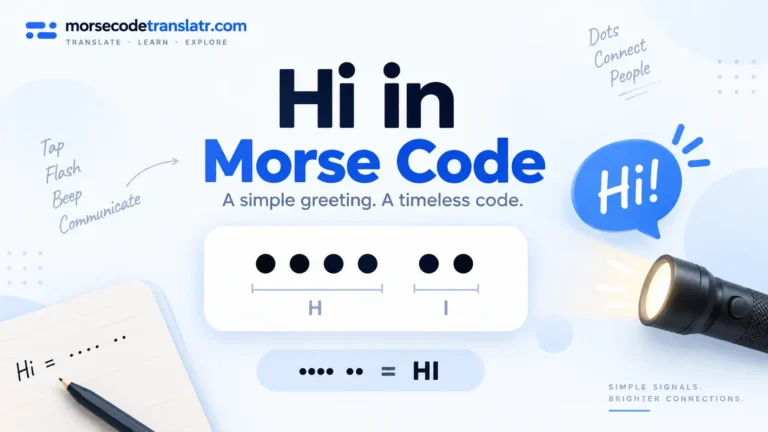
Hi in Morse Code
The international Morse code for “Hi” is:
- H → ….
- I → ..
Put the two letters together in the same order as the word: HI → …. ..
That’s all you need to write the greeting in Morse code. The space is not part of either letter’s code. It marks the separation between the H and the I. This becomes especially important when Morse code is transmitted via sound, light, or taps, as the pauses help the receiver distinguish one character from another. If you’re learning the Morse code alphabet, recognizing H and I separately makes this pattern easier to remember.
Copy and Paste “Hi” in Morse Code
Do you need a version you can copy?
For reference:
- H: ....
- I: ..
- Hi: .... ..
Keep the space between the two groups. This tells the reader that the four dots represent the H and the two dots represent the I.
How Is “Hi” Written in Morse Code?
Morse code works character by character, so you shouldn't look for a single pattern that represents the entire word.
| Letter | Morse Code | Sound Representation |
|---|---|---|
| H | .... | dit-dit-dit-dit |
| I | .. | dit-dit |
Start with the H: ....
Next, convert the I: ..
Now put the two together: .... ..
The result retains the original spelling: the H comes first, followed by the I. This is also why simply writing six dots in a row, ......, is not a good substitute for the written form. The boundary between the characters has been lost.
H and I in Morse Code
The two letters used in “Hi” have short patterns:
Letter Morse Code
- H ....
- I ..
The “H” consists of four dots, while the “I” consists of two. Neither letter contains a dash.
Together, they form: .... ..
If you’re learning the Morse code alphabet, it’s worth recognizing these two patterns separately before trying to read the entire word at speed.
What Does .... .. Mean?
.... .. means “HI.” To decode it, separate the sequence at the spaces between the letters:
- .... → H
- .. → I
Read these letters from left to right, and you’ll get “HI.” The same principle applies to longer Morse code messages. You identify each character, decode it, and then read the resulting letters in order. If you’re starting to learning Morse code, practice reading and writing short Morse words before moving to longer messages.
How Do You Say “Hi” in Morse Code?
Morse code can be transmitted through sounds, such as a sequence of short and long signals.
A dot is the short signal. A dash is the long signal.
Since both letters in the word “Hi” use dots, the sound pattern consists of six short signals divided between the two letters:
| Letter | Morse Code | How to Say It |
|---|---|---|
| H | .... | four short signals |
| I | .. | two short signals |
In spoken Morse code terminology, a dot is commonly called a “dit.” This gives the word a rhythm of four short signals, a pause between the letters, and two short signals. The important thing is not simply to make six quick sounds. The pause between the H and the I must be distinct enough for the two characters to be recognized separately.
How to Tap “Hi” in Morse Code
You can practice writing the letter with your finger on a table or other surface.
For the letter H, make four short taps:
The complete rhythm is: tap tap tap tap | tap tap
The interval between the groups is longer than the small spaces between the individual elements within a letter. Tapping is a useful way to practice, as it forces you to pay attention to both the pattern of the sign and the timing. For another popular message to practice, see I Love You in Morse code.
How to Send “Hi” With a Flashlight
A flashlight can be used to visually represent Morse code. A short flash corresponds to a dot. To send “Hi”:
- Flash four short flashes for the “H.”
- Pause to separate the letters.
- Flash two short flashes for the “I.”
The visual pattern is: •••• | •• Or in standard Morse code notation: .... ..
If you’re practicing with someone else, agree on the duration of the flashes beforehand. The receiver needs to be able to distinguish the individual flashes and the pause separating the two letters. Avoid shining a bright flashlight directly into someone’s eyes.You can also learn familiar signals such as SOS in Morse code.
How to Send “Hi” With Sound
You can use a beep, a tone, a whistle, or another short audible signal to represent each dot.
- For H, send four short tones.
- For I, send two.
The rhythm is: beep beep beep beep | beep beep
There are no long tones, since neither H nor I contains a dash. If you’re practicing Morse code by ear, pay attention to the grouping rather than trying to count a continuous series of six sounds. The pause indicates where the H ends and the I begins.
Morse Code Timing for “Hi”
Timing is an integral part of understanding Morse code. Written notation makes the separation visible through a space, but an actual transmission uses pauses.
- In standard Morse code timing:
- A dot lasts 1 unit of time.
- The interval between elements within a letter is 1 unit.
- The interval between letters is 3 units.
- A dash lasts 3 units.
- The interval between words is 7 units.
For “Hi,” only dots are needed, but the interval between letters is still important. Conceptually, the transmission looks like this:
H → .... → interval between letters → I → ..
It is this timing that prevents the two letters from being heard as an uninterrupted sequence.
How Many Dots Are in “Hi” in Morse Code?
There are six dots in total.
- The H has 4 dots.
- The I has 2 dots.
- Together: 6 dots.
There are no dashes in the Morse code for “Hi.” This makes the written pattern particularly easy to recognize once you’ve learned the two letters.
Is “Hi” Easy to Learn in Morse Code?
“Hi” and “Hello” are both common greetings, but their Morse code patterns are quite different.
Hi .... ..
“Hello” .... . .-.. .-.. ---
“Hi” has only two letters, and both use dots. “Hello” has five letters and includes several dashes, so its pattern is considerably longer. If you’re looking for a short greeting to practice, “Hi” is the most compact option. One can even use the Morse Machine to get acquainted with the rhythms of dots, spaces, and letters.
Common Mistakes When Writing Hi in Morse Code
The most common mistakes usually involve the spacing between characters, not the individual letters.
Writing the six dots together
...... The correct way to write them is: .... ..
The space separates the two letters.
Adding a dash
Neither the H nor the I requires a dash. Adding one changes the code.
Reversing the Order of the Letters
The word is H-I, so the Morse groups must appear in that order:
- H → ....
- I → ..
Ignoring Timing When Transmitting
Whether you’re tapping, blinking, or using sounds, don’t make all the pauses identical. The intervals between letters are longer than the intervals between the individual elements within a letter.
How to Remember “Hi” in Morse Code
A simple way to memorize this is to learn the two letters separately.
- Think of the H as four dots: ....
- Then, remember that the I is two dots: ..
- When you see the two groups together: .... ..
you’ll be able to recognize the greeting without having to translate the entire sequence from scratch. Another useful exercise is to alternate between reading and writing:
- Read: .... .. → HI
- Write: HI → .... ..
This helps develop recognition in both directions.
How to Decode Hi in Morse Code
If someone sends you: (.... ..) first look for the boundary between the characters.
- The first group is: .... = H
- The second is: .. = I
- Therefore, the decoded message is: HI
When decoding longer messages, use the same approach. Separate the characters, identify each Morse code pattern, and combine the resulting letters. You can also use our Morse Translator Tool to decoder longer messages.
Can You Send “Hi” Without a Morse Code Key?
Yes. A traditional telegraph key is just one way to send Morse code. For a short message, such as “Hi,” you can represent the dots with:
- Written symbols
- Taps
- Short blinks
- Audible tones
- A Morse code translator
The medium changes, but the underlying letter patterns remain the same.
Frequently Asked Questions
What does “Hi” mean in Morse code?
“Hi” in Morse code is .... ... The “H” is .... and the “I” is ...
How do you write “Hi” in Morse code?
Write the “H” as ...., the “I” as .., and put a space between them: .... ..
What does .... .. mean?
It means “HI.” The first four dots represent the H, and the last two represent the I.
How many dots are there in “Hi” in Morse code?
There are six dots in total: four for the H and two for the I.
Does “Hi” in Morse code have a dash?
No. Both letters consist entirely of dots.
How do you tap “Hi” in Morse code?
Tap four times for the H, pause between the letters, and then tap twice for the I.
How do you signal “Hi” in Morse code?
Use four short flashes for the H, pause, and then two short flashes for the I.
Can I copy and paste “Hi” in Morse code?
Yes. The sequence you can copy is .... ..
What is “H” in Morse code?
“H” is ...., represented by four dots.
What is “I” in Morse code?
“I” is .., represented by two dots.
What is “Hello” in Morse code?
“Hello” is .... . .-.. .-.. ---. It is longer than “Hi” and uses both dots and dashes.