Learn Morse Code: A Complete Beginner’s Guide
Morse code seems very simple on paper: it consists of just a few dots, dashes, and spaces between them. The real challenge is memorizing them and being able to identify them automatically.
The thing is, you don’t need to try to learn the entire alphabet all at once. Instead, you should choose a few characters and learn to recognize them by listening and practicing as you go.
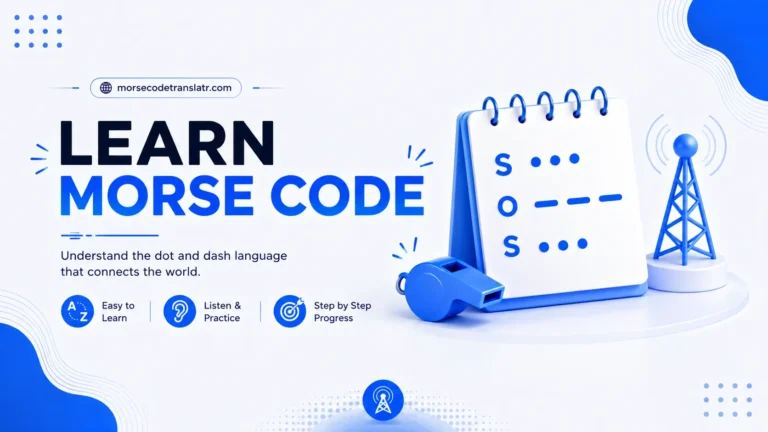
This guide will help you learn Morse code from scratch, covering topics such as the alphabet, timing, sound identification, decoding, writing, practice methods, WPM, and two well-known learning methods: the Koch and Farnsworth methods..
What Is Morse Code?
Morse code is a coding system in which characters, numbers, punctuation marks, and other symbols are represented by a series of dots and dashes. Short and long signals are typically represented by dots and dashes.For example:
For example:
- E = .
- T = –
- A = .-
- N = -.
Put those characters together and you can send complete words and messages.
Morse code can be transmitted using sound, light, radio signals, electrical pulses, or even simple taps. The medium may change, but the underlying patterns remain the same.
The form most students encounter today is International Morse code, which assigns standardized patterns to the Latin alphabet, numbers, punctuation marks, and various special characters.
How Does Morse Code Work?
Each character has its own sequence of short and long signals. A dot represents a short signal, while a dash represents a signal three times as long according to the standard timing.
Let’s take the letter A as an example:
.-
It consists of a dot followed by a dash.
The letter R is:
.-.
And the letter K is:
-.-
The individual symbols are fairly easy to understand. What takes practice is recognizing them quickly, especially when listening to Morse code rather than reading it.
Morse Code Dots and Dashes
A dot is the shortest element:
.
A dash is the longest element:
–
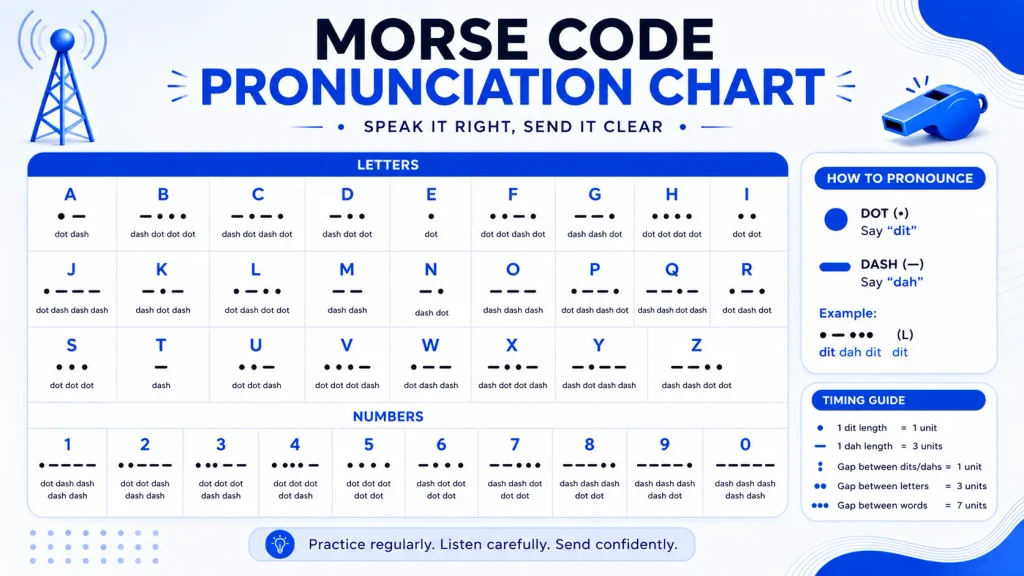
When pronouncing Morse code aloud, students often use “dit” for the dot and “dah” for the dash. This can make it easier to remember the rhythm.
For example:
A = .-
can be perceived as a short-long pattern rather than as two symbols on a page. This distinction becomes increasingly useful once you start learning Morse code by sound.
Morse Code Timing and Spacing Rules
Synchronization is one of the aspects that some beginners overlook. It’s not just about using the correct dots and dashes in Morse code. The spaces also convey meaning. Using the standard timing relationship:
- A dot lasts 1 time unit.
- A dash lasts 3 time units.
- The gap between elements within one character is 1 unit.
- The gap between two letters is 3 units.
- The gap between two words is 7 units.
Let’s say you send:
… — …
The spaces separate the three characters, allowing the receiver to recognize the S, the O, and the S separately. If the spacing is uneven, Morse code can be much harder to understand, even when the dots and dashes themselves are correct.
Learn the Morse Code Alphabet Step by Step
The alphabet is the most obvious starting point, but learning it in alphabetical order isn’t necessarily the easiest method.
A progressive method introduces simple patterns first and builds on them from there. Start with the two shortest characters:
Start with E and T
E = .
T = –
There’s nothing to memorize beyond the fact that E is a dot and T is a dash Spend some time listening to them and identifying them at random before moving on.
Add I, M, S, and O and Next, build directly on those basic signals:
| Letter | Morse Code |
|---|---|
| I | .. |
| M | -- |
| S | ... |
| O | --- |
These four are useful because the pattern is easy to see and hear. You can also start practicing combinations like: E T I M S O instead of studying each character separately.
Learn A and N
A = .-
N = -.
Notice that they are inverses of each other. This type of relationship can make memorization easier, since you aren’t treating each letter as a completely independent pattern.
Continue Building the Alphabet
Once the first group has become familiar with them, gradually add the rest of the letters.
Some useful examples are:
| Letter | Morse Code |
|---|---|
| R | .-. |
| W | .-- |
| D | -.. |
| K | -.- |
| G | --. |
| U | ..- |
| L | .-.. |
| P | .--. |
| B | -... |
Over time, you’ll be able to recognize all 26 letters without having to consult a chart.
Morse Code Alphabet Quick Reference
| Letter | Morse | Letter | Morse |
|---|---|---|---|
| A | .-
| N | -.
|
| B | -...
| O | ---
|
| C | -.-.
| P | .--.
|
| D | -..
| Q | --.-
|
| E | .
| R | .-.
|
| F | ..-.
| S | ...
|
| G | --.
| T | -
|
| H | ....
| U | ..-
|
| I | ..
| V | ...-
|
| J | .---
| W | .--
|
| K | -.-
| X | -..-
|
| L | .-..
| Y | -.--
|
| M | --
| Z | --..
|
For a more detailed reference, see our Morse Code Alphabet guide.
How to Memorize Morse Code
There are two different goals that people sometimes confuse. You can memorize what a character looks like, or you can learn to recognize it immediately when it is transmitted. The second skill requires more effort, but it is the one you should aim for if you want to listen to Morse code.
Learn the Sound, Not Just the Shape
Looking at the .- and remembering the “A” is helpful. Hearing the same pattern and immediately thinking of the “A” is much more helpful. Try to say or hear the character’s full rhythm, rather than mentally reading each symbol individually. Over time, your brain begins to associate the sound pattern with the letter.
Learn Similar and Opposite Characters Together
Some Morse characters make natural pairs:
- A = .-
- N = -.
And:
- R = .-.
- K = -.-
Seeing these relationships can make the alphabet easier to organize in your memory.
Use Rhythm-Based Memory
When Morse code is spoken, dots and dashes are usually represented by sounds like “dit” and “dah.” For example:
S = …
has a simple, repetitive rhythm.
The goal is not to spend the entire learning process reciting mnemonics. Use them when they’re helpful, and then gradually move on to recognizing the actual sound of the character.
Learn a Few Characters at a Time
Trying to memorize all 26 letters at once usually leads to more confusion than progress. Learn a small group of letters, test your knowledge, and add another letter once you’ve become familiar with the previous ones.
Learn Morse Code by Sound
If you want to feel comfortable receiving messages in Morse code, listening practice should be part of your routine from the very beginning. A visual chart shows you what Morse code looks like. Listening to it teaches you how it sounds in real time.
How to Start Listening as a Beginner
Don’t start with long messages at a speed you can’t keep up with. Start with a small set of characters that are familiar to you.
For example, practice distinguishing:
- E = .
- T = –
Next, add:
- I = ..
- M = —
- S = …
- O = —
Listen to random combinations and identify them before looking at the answers.
A Simple Listening Exercise
- Choose five characters you already know.
- Repeat them in random order.
- Write down each answer without looking at the table.
- Then, check your answers.
Don’t worry about speed. At this stage, getting the answers right is more important than being fast.
How to Read Morse Code
Reading written Morse code is called “decoding”: you start with the dots and dashes and gradually reconstruct the original text.
Let’s look at this example: …. . .-.. .-.. —
Break it down into characters:
- …. = H
- . = E
- .-.. = L
- .-.. = L
- — = O
The result is: HELLO
. Spaces are essential because they indicate where one character ends and another begins.
A Simple Decoding Process
When you see a message in Morse code:
- Separate the individual characters.
- Match each pattern to a letter or symbol.
- Write the letters in order.
- Separate the words correctly.
- Read the complete message.
Start with short words. Once you feel comfortable with them, move on to phrases.
How to Write Morse Code
Writing in Morse code is the reverse process. Instead of looking at a sequence of signals and deducing the text, you start with the text and convert each character into its Morse code pattern.
For example: HELP
- H = ….
- E = .
- L = .-..
- P = .–.
So, the complete word is: …. . .-.. .–. When writing a longer message, make sure the individual letters are clearly separated.
Practice Encoding Your Own Words
Choose a common word and convert it without looking at the answer. For example:
RADIO
becomes:
.-. .- -.. .. —
Then, check your work using a reference guide or a Morse code translator. Doing this regularly strengthens your memory, since you’re actively retrieving the patterns rather than simply recognizing them.
Learn Morse Code Numbers and Punctuation
Once you’ve become familiar with the alphabet, you can add numbers and punctuation marks to your exercises.
| Number | Morse | Number | Morse |
|---|---|---|---|
| 0 |
----- | 5 |
..... |
| 1 |
.---- | 6 |
-.... |
| 2 |
..--- | 7 |
--... |
| 3 |
...-- | 8 |
---.. |
| 4 |
....- | 9 |
----. |
The numbers have a pattern that makes them easier to remember. Five is: ….. So From 5 toward 0, dashes are added from the beginning:
- 5 =
..... - 6 =
-.... - 7 =
--... - 8 =
---.. - 9 =
----. - 0 =
-----
From 5 toward 0, dashes are added from the beginning. The reverse pattern works from 5 toward 1.
Morse Code Punctuation and Symbols
Some common punctuation marks include:
| Symbol | Morse |
|---|---|
| Period | .-.-.-
|
| Comma | --..--
|
| Question Mark | ..--..
|
| Apostrophe | .----.
|
| Slash | -..-.
|
| Hyphen | -....-
|
| Colon | ---...
|
| Semicolon | -.-.-.
|
| Equals Sign | -...-
|
You don’t have to memorize them all right from the start. Focus on the alphabet first, and as your messages get more complex, gradually introduce numbers and punctuation marks.
The Best Way to Learn Morse Code
There is no magic technique that works the same way for everyone. What matters is how you practice. A good learning routine combines several elements:
Learn Characters by Sound
This helps you move toward automatic recognition.
Start Small
It introduces a manageable number of characters instead of trying to learn the entire alphabet all at once.
Practice Regularly
It’s easier to keep sessions short and frequent than to have occasional marathon sessions.
Focus on Recognition
Try to recognize the characters rather than consciously calculating every dot and every line.
Practice Both Directions
Work on:
Morse → text
and:
text → Morse
Morse Code Practice for Beginners
Learning is much easier when you stop thinking of Morse code as something you have to memorize and start using it. The best thing for practicing is Morse Machine we made with love.
Practice Individual Characters
Listen to or look at one character at a time. Don’t rush. Make sure you know why your answer is correct.
Practice Random Characters
Practicing in a random order prevents you from memorizing a predictable sequence. If you always practice A, B, C, D in that order, you may start to anticipate the answer instead of recognizing the Morse code pattern.
Practice Short Words
Once you know enough letters, move on to short words.
Some examples are:
- HI
- YES
- NO
- SOS
- HELP
- HELLO
Short words serve as a bridge between individual characters and actual messages.
Practice Decoding
Take a message in Morse code and translate it into English. Start slowly and check for mistakes afterward.
Practice Encoding
Take common words and write them in Morse code. This is a way to see if you can remember the patterns without having seen them before.
Practice With Audio
Listening practice is especially useful because it eliminates visual cues. Listen, write down what you hear, and then compare your answer with the original message. you can also decode audio using our morse audio decoder.
Check Your Answers With a Morse Code Translator
A translator can be a useful tool for checking your work. Try to solve the exercise on your own first. Then, use the our free translator to confirm the answer. This way, the tool becomes part of the learning process, rather than replacing it.
A 15-Minute Daily Morse Code Practice Routine
You don’t need a complicated schedule. A simple 15-minute session might look like this:
- Minutes 1–3: Review the characters you’ve already learned.
- Minutes 4–7: Listen to random characters and identify them.
- Minutes 8–11: Decode short words.
- Minutes 12–14: Convert common words into Morse code.
- Minute 15: Review any mistakes you made.
The next day, spend some time on the characters that gave you trouble, rather than automatically moving on to something new.
Common Morse Code Learning Mistakes
Trying to Memorize Everything at Once
The entire alphabet seems easy to handle until you try to remember each pattern without a reference.
Break it down into smaller groups.
Relying Only on a Visual Chart
A chart is an excellent reference, but it doesn’t teach you what Morse code sounds like.
Start practicing your listening comprehension early on.
Counting Every Dot and Dash
Counting can be helpful at first, but relying on it forever slows down recognition.
Train yourself to listen for complete patterns.
Ignoring Timing and Spacing
Even the correct symbols can be difficult to understand if they aren’t pronounced with the right rhythm.
Practice the rhythm along with the characters.
Practicing Inconsistently
It’s more helpful to spend a little time on it several times a week than to study intensively just once and then forget about the subject.
Increasing Speed Too Quickly
If you’re guessing more than you’re recognizing, take it easy.
The goal is to develop a skill, not to win a race against yourself.
Only Practicing Morse-to-Text
Decoding is important, but encoding tests a different part of your memory.
Practice both.
Never Testing Yourself
Reading a chart can give you the impression that you know something because it looks familiar.
Close the chart and test yourself.That’s when you’ll discover what you really remember.
Morse Code Practice With Real Words
Real words make the exercise more interesting and give you a reason to use the characters you’ve learned.
| Word | Morse Code |
|---|---|
| HELLO | .... . .-.. .-.. --- |
| HELP | .... . .-.. .--. |
| YES | -.-- . ... |
| NO | -. --- |
| SOS | ... --- ... |
Try to figure out the English word and decode the Morse code on your own.
Once you feel confident, move on to longer words and short phrases. If you want to see more examples of phrases, check out our guide to words in Morse code.
Fun Ways to Practice Morse Code
Practice doesn’t always have to involve sitting in front of a chart.
Flashlight Morse Code
Use short and long flashes to represent dots and dashes.
Tapping Morse Code
Tap a table or another suitable surface using short and long taps.
Practice With a Friend
One person sends a character or word while the other writes down the answer.
Then switch roles.
Turn Everyday Words Into Morse
Pick a word you see during the day and try converting it mentally.
Use Quizzes and Games
Random quizzes can make Morse code practice less monotonous and provide a quick way to assess your progress. The method is less important than the fact that you are actively recognizing and producing Morse code.
Learn Morse code by images
It is also an effective learning method. You just need to understand Morse code by images and remember the alphabet, numbers, and punctuation symbols in Morse code, and that is it. Follow these steps below.
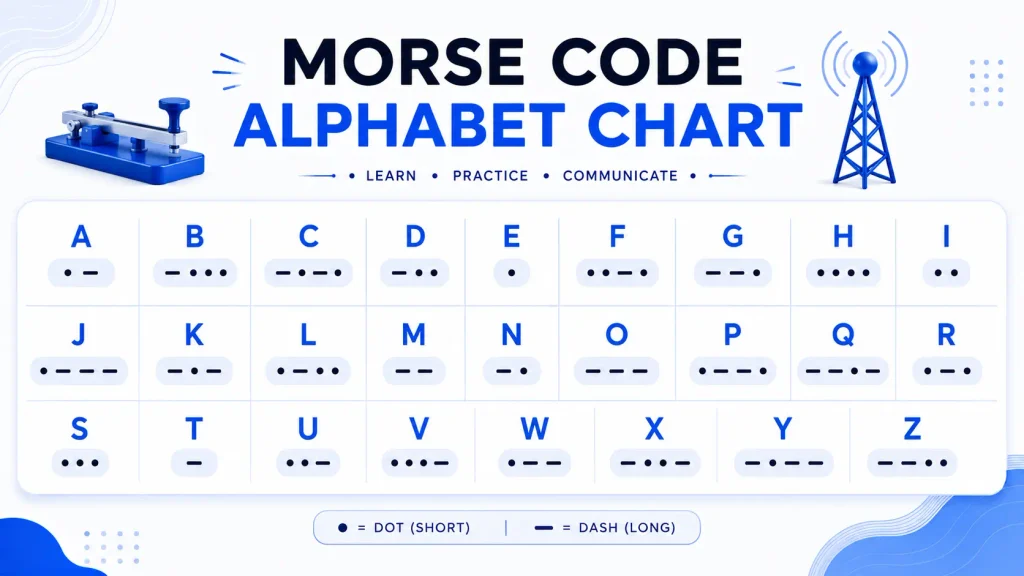
Study the Morse Code Chart Carefully:
Studying the chart is the first step to learning Morse code. The chart represents each alphabet in a unique pattern of dots and dashes. By learning the chart, you can remember the symbols easily, which helps you to recognize Morse code accurately. Once you become familiar with the chart, learning Morse code becomes super easy.
Learn the Basics:
Learn the most frequent letters (E, T, A, O, I, N), then slowly less common letters. Make sure to use our Morse Code Translator to translate letters into Morse code for better learning and understanding. Morse code is all about only two signals, which are dots and dashes. Dot is called dits, and dash is known as dahs in Morse code sound. ( A is symbolised by “·–”).
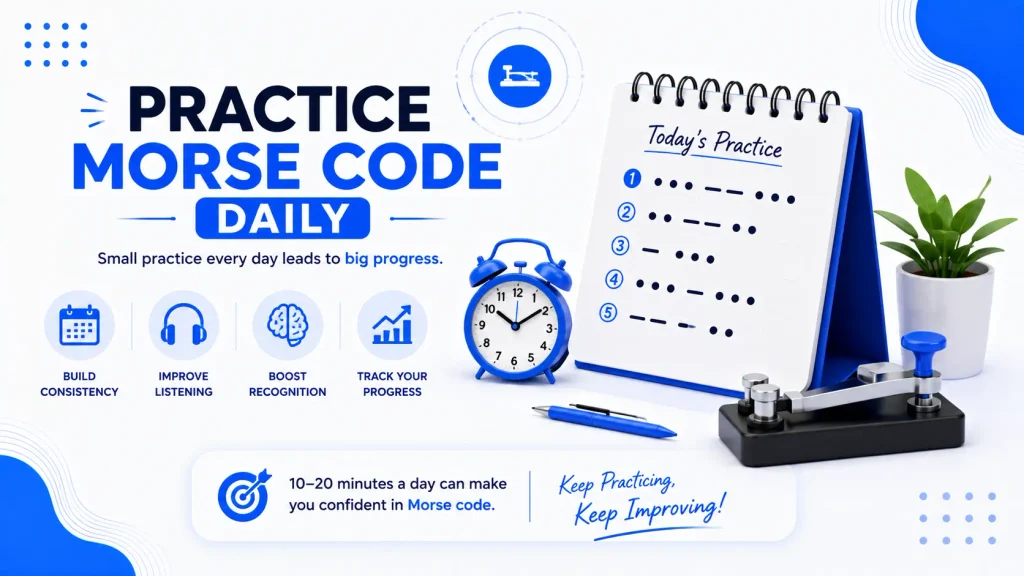
Practice Regularly:
However, the only way to learn and get really good at Morse code fast is to practice daily. Practicing helps you learn the patterns of dots and dashes more easily and makes you better at figuring them out. Using a Morse Code Translator while you practice can give you instant translation and help you learn from your mistakes. Practicing just 10-15 minutes a day.
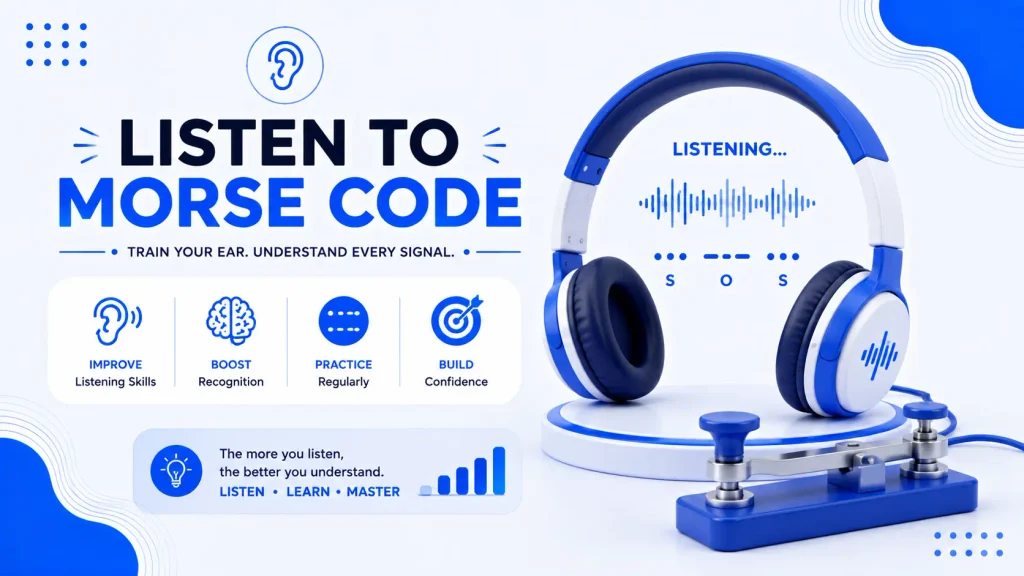
Listen and Repeat:
Listening to the sounds of dots and dashes and saying them out loud helps you learn to recognize Morse Code patterns. Using a Morse Morse Machine with sound lets you listen and see how well you did. Doing this over and over helps you get better at timing, remembering, and understanding Morse Code fast.
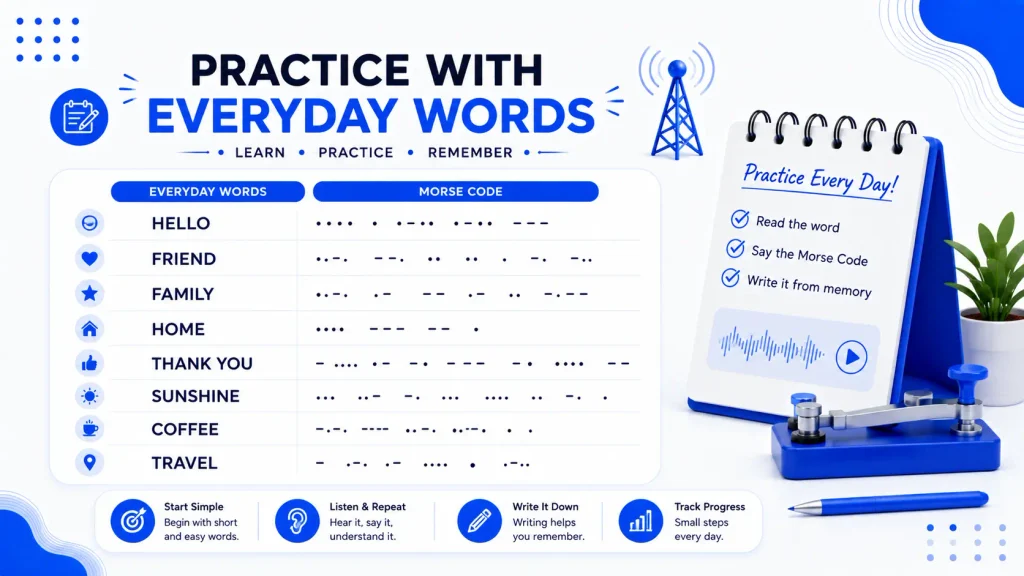
Practice with Everyday Words and text:
Practicing Morse code with everyday words helps you learn it faster and remember the dot and dash pattern easily. Start with simple words, such as names or greetings, and use a Morse Code Translator to confirm your answer’s accuracy. Real-world practice helps improve your confidence in deciphering Morse code.
Once you learn Morse code, a world of possibilities opens up. You might chat with fellow radio enthusiasts, send urgent messages in a crisis, or revel in the thrill of mastering a rare and fascinating skill. With Morse code, your words can travel in ways that feel both adventurous and secure. Try our online Morse Code Translator for practicing and analyzing the interactive Morse code chart made specially for you.
Why Should You Learn Morse Code?
People learn Morse code for different reasons.
It can also be a rewarding exercise for listening, memory, timing, and pattern recognition. Some are interested in amateur radio or the history of communications. Others enjoy learning unusual skills, experimenting with light and sound, solving puzzles, or simply understanding a communication system that has been used for generations. You don’t need a practical reason to learn it. Learning a skill simply out of curiosity is reason enough.
Frequently Asked Questions
What is the easiest way to learn Morse code?
Start with a small number of characters, practice them regularly, and learn both their sound and their written pattern. Gradually add new characters as your recognition skills improve.
What is the fastest way to learn Morse code?
There are no shortcuts that can replace practice. A structured routine that combines auditory recognition, active repetition, decoding, and encoding is more effective than trying to memorize the entire alphabet all at once.
How long does it take to learn Morse code?
Learning the basic alphabet can be relatively quick, but becoming comfortable with Morse code by ear takes longer. How often you practice and your learning method greatly influence your progress.
Can I learn Morse code on my own?
Yes. You can learn the basics independently using a Morse code chart, auditory practice, exercises, and a way to check your answers.
Can I learn Morse code without sound?
Yes. Written Morse code can be learned visually. However, listening practice is important if, over time, you want to understand Morse code when it’s transmitted as sound.
Should I learn Morse code by sight or by ear?
Use both. Sight is useful for learning and checking patterns, while listening practice helps develop real-time recognition.
How do I memorize Morse code?
Learn a few characters at a time, pay attention to their rhythm, practice active memorization, and gradually transition from visual recognition to auditory recognition.
What is the Koch method?
The Koch method is a progressive approach to learning Morse code in which learners start with a small set of characters and add more as recognition improves, typically keeping each character at a manageable speed.
What is the Farnsworth method?
The Farnsworth method uses relatively faster character speeds while adding extra spacing between characters and words. The spacing can be reduced as the learner becomes more comfortable.
What does WPM mean in Morse code?
WPM stands for “words per minute” and is a common way to describe the speed of Morse code.
Is Morse code difficult to learn?
The basic alphabet is manageable, but achieving speed and fluency—especially when listening—requires regular practice.
How many minutes a day should I practice Morse code?
Even a short daily session can be helpful. Between 10 and 20 minutes of focused practice gives you enough time to review the characters, listen, decode, and practice encoding without making the routine difficult to maintain.
Can I learn Morse code on my phone?
Yes. A phone can be useful for looking up a Morse code chart, listening to practice audio clips, taking quizzes, and checking your encoding or decoding exercises.