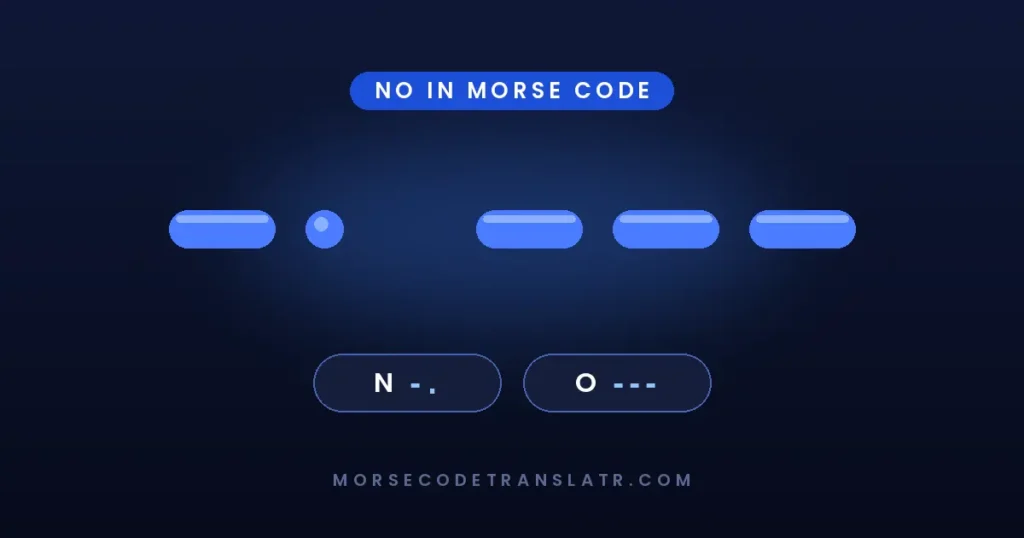
No in Morse Code: -. ---
-. ----.
O → ---N · O — two letters, five signals.
Type it yourself:
- Type
-.for N. - Add a space.
- Type
---for O.
What Is “No” in Morse Code?
“No” is one of the shortest genuinely useful words in Morse code: two letters, five signals total. N is dash-dot (-.), O is dash-dash-dash (---). Put a clean letter gap between them and you get -. ---.
| Letter | Morse code | Spoken as |
|---|---|---|
| N | -. | dah-di |
| O | --- | dah-dah-dah |
How to Say “No” in Morse Code Out Loud
Morse speakers say “di” for a dot and “dah” for a dash. Said out loud, “no” is “dah-di, dah-dah-dah” — with a real pause where the comma is. That pause is doing real work: it’s the letter gap, and without it the two letters smear into one unreadable run.
The rhythm is its own memory aid. N is long-then-short. O is three long, even beats. Say “dah-di DAH-DAH-DAH” a few times and your mouth remembers the shape before your brain has to.
Letter Spacing and Timing: The Part Beginners Get Wrong
Morse timing is measured in units, not seconds — it scales to any speed:
- Dot = 1 unit
- Dash = 3 units
- Gap between letters = 3 units
- Gap between words = 7 units
The letter gap is where “no” most often breaks. Run N and O together and the receiver gets a blur nobody can decode:
- Wrong:
-.---— where does N end and O begin? Nobody can tell. - Right:
-. ---— the 3-unit gap draws the boundary.
The same rule scales up to words. “NO NO” is sent as -. --- / -. ---, with a full 7-unit silence between the words — long enough that no one hears it as a single blur.
What Does -. --- Mean?
Read it back the other way: dash-dot is N, three dashes is O. So -. --- decodes to NO. If a decoder ever hands you something unexpected, check the letter gaps first — they’re the usual culprit.
How to Send “No” in Morse Code
The sequence never changes — only the tool does:
- Send N:
-. - Wait 3 units.
- Send O:
---
By Sound
A short beep is a dot; a beep three times as long is a dash. Whistles, radio tones, and table taps all work the same way: a long beep, a short beep, a pause, then three long beeps.
By Light
A flashlight works like sound made visible: a short flash is a dot, a long flash is a dash. Flash long-short for N, hold the dark gap, then flash three longs for O. The darkness between the letters is part of the message — don’t rush it.
By Touch
Tap it out on a table or someone’s arm: a quick tap is a dot, a longer press is a dash. Press-tap, pause, press-press-press.
“No” vs “Yes” in Morse Code
These two travel as a pair, and they sound nothing alike:
| Word | Morse code | Signals |
|---|---|---|
| NO | -. --- | 5 |
| YES | -.-- . ... | 8 |
“No” is short and heavy — nearly all dashes. “Yes” is longer and lighter, mixing a complex Y with two dot-only letters. Learn them together and each one makes the other easier to recognize.
See also: our full Yes in Morse Code guide.
Is “N” Alone Enough to Say “No”?
Sometimes — but know what you’re doing. In standard on-air procedure, the single letter N (-.) is the recognized prosign for “Negative” — the official shorthand for “no” — and experienced operators do use it.
Out of context, though, N is just a letter — it could start any word. If there’s any chance of confusion, spell out the full -. ---. And one firm rule: “no” is not a distress signal. Never use it as one. The emergency call is SOS (... --- ...).
Common Mistakes to Avoid
- Reversing the letters —
--- -.is not “no.” N comes first. - Skipping the letter gap —
-.---is unreadable; the 3-unit gap is mandatory. - Adding an extra dash — O is exactly three dashes; a fourth changes the pattern entirely.
- Writing N as
-.-— that’s K. N is-.: one dash, one dot. - Mixing up NO and GO —
-. ---vs--. ---; check the first letter.
Where People Use “No” in Morse Code
- Classroom games and quizzes — the classic yes/no buzzer round.
- Puzzles and escape rooms — binary answers fit Morse perfectly.
- Tattoos and jewelry — short, symmetrical, meaningful. Keep dashes about 3× dot length, keep N and O grouped with a visible gap between them, and verify the code in a translator before ink.
- Amateur radio — quick negative replies without breaking rhythm.
- Emergency confirmation — a fast, unmistakable “negative” when voice isn’t an option.
Related Morse Code Phrases
Key Takeaways
- “No” in Morse code is
-. ---— N (-.) plus O (---). - Said aloud: “dah-di, dah-dah-dah.”
- The 3-unit letter gap is what keeps it readable; timing is units, not seconds.
- Single N means “Negative” on the air, but spell out NO to be safe.
- Learn it with “yes” (
-.-- . ...) — the pair sticks better together.
Frequently Asked Questions
What is “no” in Morse code?
-. --- — that’s N (-.) followed by O (---).How do you say “no” in Morse code out loud?
How do you write “no” in Morse code?
-., leave a letter-sized gap, then write ---. Like this: -. ---.What is “yes” in Morse code?
Can I copy and paste “no” in Morse code?
-. --- in plain characters that paste anywhere.How do I send “no” with a flashlight?
Why does spacing matter so much?
-.---, which nobody can decode. Spacing is what turns signals into letters.Is “N” alone enough to say “no”?
-. --- to avoid confusion.Is “no” the same in Morse code everywhere?
-. --- means “no” in every country.What does -. --- mean?
-. --- mean?