Morse Code Alphabet: Complete A to Z Chart, Letters & Symbols
Morse code alphabet A to Z represents letters, numbers, and symbols in a pattern of dots and dashes to make a secret conversation between two people. You can use our Morse code alphabet translator to decode and encode Morse code alphabet, numbers, and symbols.The Morse code alphabet converts each letter to dots and dashes. If you want the Morse code alphabet or want to know how a letter can be converted to Morse code, the chart provided here will come in handy. The alphabet in Morse code is based on the Morse code patterns for the 26 English letters. Some examples include .-. for B, -… for C, and … for S. The chart uses the standard International Morse Code patterns for the 26 English letters. Each letter has its own sequence.
Morse Code Alphabet Chart A to Z
The dots (short signals) and dashes (long signals) are different for each letter. All pairs of letters have different patterns. The table below works as a simple visual chart, easy to scan whether it’s a quick reference or a first look at the full alphabet for a beginner. Here is the complete Morse code alphabet chart, from A through Z.
Common Morse Code Punctuation
Useful punctuation marks commonly used with International Morse Code.
Practice Morse Code
Test yourself by identifying the letter represented by the Morse code.
.-
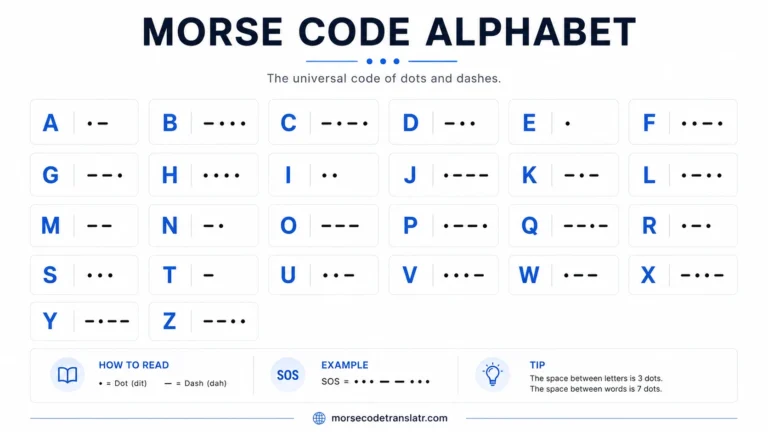
The mapping from A to Z is uniform in all the sources on Morse Alphabet that have been researched.
What Is the Morse Code Alphabet?
The Morse alphabet comprises different combinations of dots and dashes used to symbolize individual letters. In this case, a dot refers to the shorter signal, while a dash refers to the longer signal. Individual letters are represented using various combinations of these fundamental signs. For instance, E is represented by only one dot, T by one dash, and A by a dot-and-dash combination.
| Letter | Morse Code |
|---|---|
| E | . |
| T | – |
| A | .- |
| N | -. |
| S | … |
| O | — |
These patterns can be conveyed using sounds, light, or physical signals. This is what makes Morse code applicable in more ways than just printed language.
How Morse Code Letters Work
The Morse alphabet character is made up of dots and dashes in a particular arrangement. Changing the arrangement results in a different letter. For example:
| Letter | Morse |
|---|---|
| A | .- |
| N | -. |
Both have a dot and a dash, however, A begins with the dot while N begins with the dash.
A longer example is HELLO:
| Letter | Morse |
|---|---|
| H | …. |
| E | . |
| L | .-.. |
| L | .-.. |
| O | — |
So: HELLO = .... . .-.. .-.. ---
The spaces shown above separate the individual letters. This distinction becomes important when you start decoding complete Morse messages. See how individual letters come together to form a complete phrase in Hello or also Love in Morse Code.
Dot and Dash Meaning in Morse Code
The two symbols have different signal lengths.
- Dot (.) is the short signal.
- Dash (–) is the long signal.
When Morse is spoken or acquired orally, dit for dot and dah for dash is used most often. As an illustration, A (.-) could be spoken as dit-dah, whereas S (…) would be dit-dit-dit. It may be more effective to think in terms of rhythm than just to look at the characters when learning Morse through sounds.
Morse Code Timing and Spacing
Not only does Morse code involve a combination of dots and dashes; it also depends on timing to distinguish its elements.
| Signal or Pause | Duration |
|---|---|
| Dot | 1 unit |
| Dash | 3 units |
| Gap between symbols in a letter | 1 unit |
| Gap between letters | 3 units |
| Gap between words | 7 units |
These timing relations are also evident in the researched Morse references.
For example, the two elements in A (.-) have a short gap between them. When the character ends, the longer gap indicates that the next signal belongs to another letter. In cases where Morse Code is written rather than telegraphed using timing, spaces are usually employed to differentiate between characters, while a slash is often used for word separation.
How to Read the Morse Code Alphabet
The most straightforward method for decoding Morse code is by dividing a message into separate character sequences. Suppose you receive: …. . .-.. .-.. —
Look up each group separately:
| Morse | Letter |
|---|---|
| …. | H |
| . | E |
| .-.. | L |
| .-.. | L |
| — | O |
The result is HELLO.
It can also be done backwards. Use a common word to begin with and find the Morse code of each letter. The sequences can then be put side by side with proper spacing between characters.
How to Learn the Morse Code Alphabet
You do not need to memorize all 26 letters in one sitting. A better approach is to recognize related patterns and gradually build your recall.
Start With the Shortest Letters
The two simplest letters are:
E = .
T = –
Then move to the two-signal characters:
A = .-
I = ..
M = —
N = -.
After that, you can work through the three-signal and four-signal letters. Grouping letters by pattern length is one of the learning approaches used by the researched Morse resources.
Learn the Rhythm, Not Just the Symbols
A printed Morse alphabet chart can be helpful when identifying an unknown letter, but visual memory plays just one role in learning Morse code. Try saying or hearing the patterns:
S = dit dit dit
O = dah dah dah
SOS = dit dit dit dah dah dah dit dit dit
This gives each character a rhythm that you can recognize without mentally counting every symbol. These two letters combine to form the famous SOS Morse Code distress signal.
Practice With Short Words
Once individual letters become familiar, use short words instead of repeatedly reviewing the alphabet. For example:
HI = …. ..
YES = -.– . …
NO = -. —
SOS = … — …
Then move to longer words and short sentences. To learn dots, dashes, rhythm, and recognition step-by-step, check out our guide on How to Learn Morse Code.
Morse Code Punctuation Chart
Morse Code doesn’t consist only of letters and digits. Punctuation marks too have their own codes.
The researched reference also lists additional characters such as &, $, _, quotation marks, and inverted punctuation.
Reading and Writing Morse Code letters
Once learned, the Morse code alphabet can be read easily because of a few things:
- Spacing is significant: The message becomes an unreadable sequence of dots and dashes if spacing between letters and words is not done properly.
- Spaces are not separated with a specific code: A pause is indicated by a slash, or a longer gap.
- There is also punctuation: Periods, commas, and question marks have their own Morse patterns, but they do not appear very frequently compared to the letters.
- The case is not significant: Morse code doesn’t have any different patterns for uppercase letters and for lowercase letters.
- Every letter is made from just two symbols: The Morse code alphabet uses dots and dashes. These are just short and long signals mixed in various ways. This mix makes it easy to learn the system.
The International Morse Code Alphabet and the ITU Standard
- Two systems exist: American Morse code was the original version used on early telegraph lines. The international standard adopted later simplified several patterns and removed inconsistent spacing within certain letters.
- It’s why the international version became standard: The fixes are why it is the version used almost everywhere now.
- Officially defined by the ITU: the ITU, the International Telecommunication Union, has officially defined the chart at the top of this page with its Recommendation M.1677.
- It keeps everyone in sync: One common standard is why timing and letter patterns are the same regardless of the message being sent from an amateur radio operator in one country and a maritime signal station in another.
- It’s the version to use today: Nearly every modern chart, translator, and radio operator works from this version, unless a message specifically references old telegraph history.
Common Morse Code Letter Pairs That Are Easy to Mix Up
Some letters look similar when you are learning them visually. For example:
- A = .-
- N = -.
- D = -..
- U = ..-
- R = .-.
- K = -.-
The symbols themselves are simple, but their order matters. Practicing similar-looking patterns together can help prevent accidental reversals.
Common Morse Code Alphabet Mistakes
Mixing Up the Order
.- is A, while -. is N. Counting the symbols is not enough. You need to recognize their order.
Ignoring Spacing
A Morse message needs meaningful separation between characters and words. Without it, a sequence can become difficult or ambiguous to decode.
Learning Only From a Static Chart
A chart is useful for reference, but Morse is also an audio and timing-based system. Listening and tapping can help you develop recognition beyond visual lookup.
Trying to Memorize All 26 Letters at Once
Break up the alphabet into small segments. Begin with the smallest units first and proceed to larger segments.
Fun Ways to Practice the Morse Alphabet
You can practice Morse without specialized equipment.
Use Sound
Listen to individual letters and identify them without looking at the answer.
Use Light
A flashlight can represent dots with short flashes and dashes with longer flashes. This gives you a practical way to practice sending and receiving patterns.
Use Tapping
A table or other surface can turn Morse into a simple tapping exercise. Keep the difference between short and long signals consistent.
Translate Your Own Words
Write an everyday word, translate each letter to Morse code, and then attempt to decipher the message without seeing the original word.
You can write your name using Morse:
- By transforming names, dates, or phrases into dots and dashes, the letters take on a more personalized form.
Slowly start, then speed up:
- Being precise is more critical than being quick initially.
You should read before you check:
Try to decode a message by memory only, and then compare it with the chart. It is better to get it wrong than right. This is where an online Morse code translator becomes useful. You can move between ordinary text and Morse code while checking whether each letter is correct.
Tips to Remember the Morse Code Alphabet
It is easier to remember 26 letters by grouping them into useful groups.
- The best starting point is short letters: E (·) and T (−) are short letters consisting of one symbol each, whereas A (·−), I (··), M (−−), and N (−·) are two-symbol letters. These letters need to be remembered first because they can form longer letters.
- A pattern can always be converted into a rhythm word: By reading a pattern as either short or long sound (“dit” for dot and “dah” for dash), a rhythm becomes more memorizable compared to reading the symbols.
- It is advisable to come up with a phrase that will help you remember difficult letters: F (··−·) may be connected to “Find it fast,” L (·−··) may be linked to “Learn it loud.” It is just something that pops up in your mind instantly.
- Group opposite letters: Letters such as N (−·) and A (·−) are opposite in their structure, which makes it easier to remember them if they are grouped together.
- Try spelling words before moving to the whole alphabet: It is recommended to use words instead of the alphabet in your practice.
- Once you know the alphabet, the easiest next step is practicing complete Morse Code Words.
Where the Morse Code Alphabet Is Still Used
The Morse Code did not completely vanish along with the arrival of radio waves and digital communications. The alphabet continues to find its place wherever there is a need for a low-bandwidth, simple signal as opposed to speed. There are several historical incidents that demonstrate the relevance of this language.
- Aviation: Pilots identify their location based on VOR navigational beacons. These beacons send out Morse identification codes in a loop that allows the pilot to validate the signal even when his cockpit displays malfunction.
- Maritime signaling: In case the radio fails, ships and lighthouses use Morse signaling by means of light flashes.
- Amateur radio: Amateur radio operators who hold licenses continue to use Morse Code, also known as CW. If voice transmissions become weak, this language breaks through. Amateur radio operators were the first ones to act after the Haiti earthquake in 2010. Even before the official communications became available, they organized medical teams for the area.
- Time to be quiet: In 1966, Navy Pilot Jeremiah Denton was taken for a television interview by his captors. Since he could not speak, Denton used Morse Code to blink out “TORTURE”. The captors missed this message that reached U.S. Naval Intelligence and proved that American prisoners were tortured.
- Emergencies: The universal distress signal, “SOS,” which consists of three dots, three dashes, and three dots, is known to everyone even without any knowledge of Morse code.
Overview of Morse code letters
Morse code letters are part of the Morse code alphabet, where each letter is represented by a pattern of dots and dashes. This Morse code chart follows international Morse code standards and helps learners, students, and enthusiasts practice easily. You can also hear the Morse code for each letter by pressing the speaker icon, making learning interactive and fun. This Morse code chart is designed for Morse code learners to learn Morse code fast by recognizing dots and dashes and by hearing Morse code A to Z sounds, such as ( A in Morse code written as .- ).
In the world of Morse code, it’s important to know how to pronounce Morse code symbols for successful communication. Below is a short guide on pronouncing Morse symbols correctly.
Dot (.) – “Dit”: A dot in Morse code is referred to as a “Dit,” which rhymes with “fit.” It is a short sound that plays for one unit of time. Dots serve as a fundamental component of Morse code used in letters, numbers, and symbols. As an example, the letter E in International Morse code uses only one dot(·).
Dash (-) – “Dah”: The dash –, referred to as “dah.” It is pronounced as “dah.”Its sound duration is a bit longer than that of the dot and lasts for three time units. For example, the letter T in International Morse code is written as a single dash (–).
Spacing: In Morse code, spacing is crucial for conveying messages clearly. The gap between the dots and dashes in a single character is equivalent to one dot (dit). The separation between letters within a word equals three dots (three dits). The interval between words is seven dots (seven dits). This spacing makes the Morse code message clear and easy to understand.
For example, the Morse code for letter A is .- (dot–dash). When vocalizing it, you would say “dit-dah.”
Conclusion
With a basic understanding of how the combination of dots and dashes is used to form each letter of the Morse code alphabet, deciphering this code becomes fairly easy. You can use the A-Z chart for any new pattern you come across and practice to recognize words through sound and timing.
A handy tool for deciphering and coding messages, the Morse code alphabet can always be referred to. When you have to translate the entire message into Morse Code, you can make use of the Morse Code Translator to encode or decode your message.
Frequently Asked Questions
To memorize the alphabet code, start by understanding dots and dashes from our chart. Study 5 letters daily using a Morse code chart. Listen to “dit” (dot) and “dah” (dash) sounds from our special design chart that also plays Morse code to help you learn fast.
I LOVE YOU ( .. / .-.. — …- . / -.– — ..- ) THANK YOU (- …. .- -. -.- / -.– — ..-) GOOD MORNING ( –. — — -.. / — — .-. -. .. -. –.) SOS (… — …) HELP ( …. . .-.. .–.)HI (…. ..)
Morse code alphabet refers to the technique where each letter of the alphabet has its own unique representation through dots and dashes.
There are 26 letters, from A through Z.
A is: .-
B is: -…
C is: -.-.
S is: …
O is: —
Z is: –..
Convert each letter separately and place a space between the Morse patterns. For example, HELLO is: …. . .-.. .-.. —
A is .-, B is -…, and C is -.-.. They’re a good starting point since all three follow the same basic dot and dash logic used across the rest of the alphabet.
A dot is the shortest possible signal, a brief sound, flash, or tap of one unit of time. All the letters are made up from dots and dashes in a specific order and time.
With practice, letters become identifiable by their rhythm rather than counting dots and dashes. Short, common letters such as E, T, A and I are usually the first to become automatic.
Early telegraph lines used American Morse code. International Morse Code is used almost everywhere. It simplified patterns, became a global standard, and has become the most widely used version.
The simple, unmistakable, easily communicated three dots and three dashes SOS was selected. It does not represent particular words. It became standard because the pattern itself is nearly impossible to misread. You can also learn more about SOS in Morse code.
Yes, each of the numbers 0 through 9 and common punctuation marks have their own fixed Morse pattern, which is made using the same dot-and-dash scheme as the letters.