
SOS Morse Code
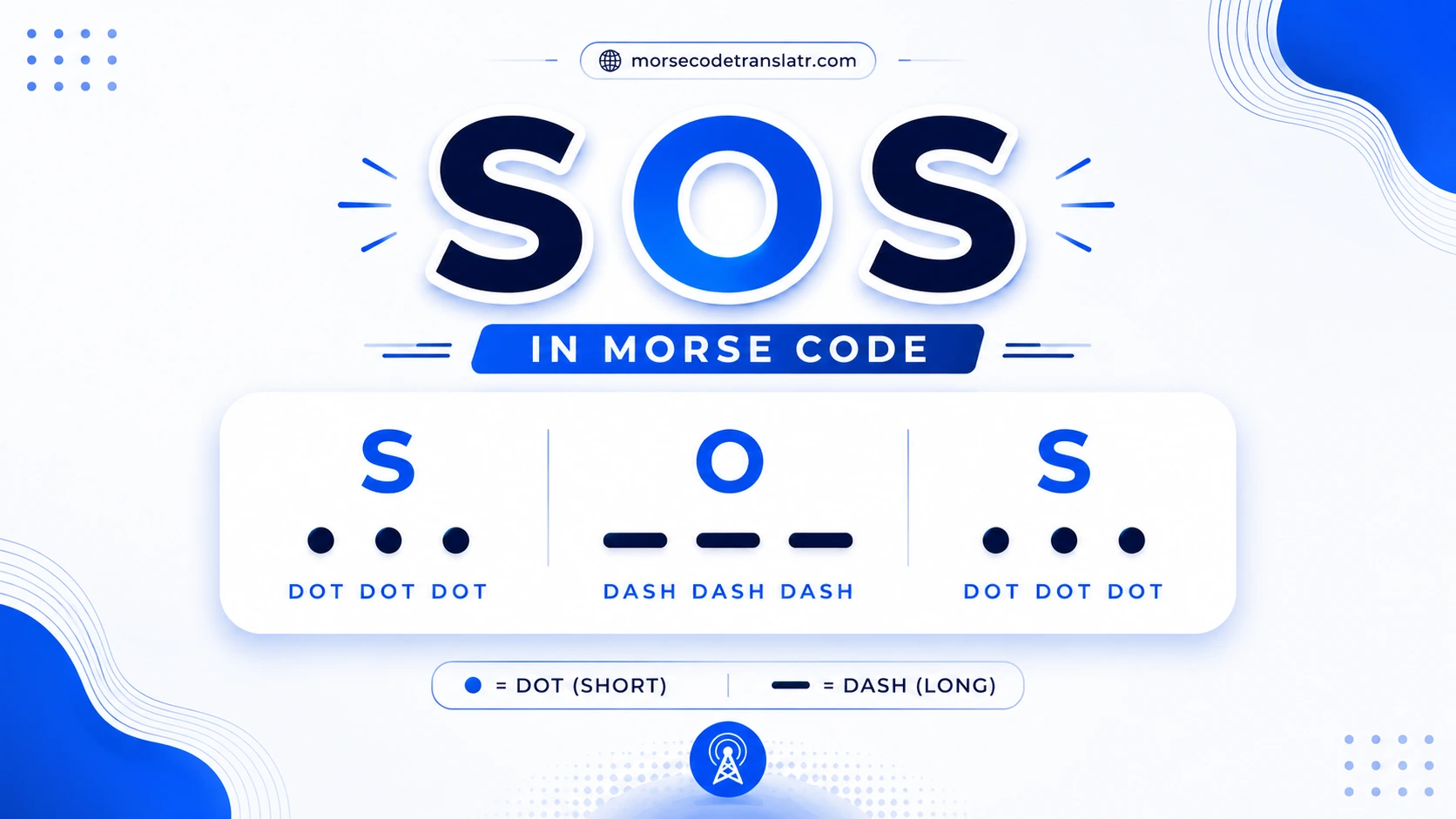
The SOS signal in Morse code is really simple. It is three dots, then three dashes, then three dots again. Everyone around the world knows what SOS means. It is a call for help when you are in trouble. When people send the SOS signal, they do not stop between the dots and dashes. They just keep going. The SOS signal is special.
SOS does not actually mean “Save Our Souls” or “Save Our Ship”. A lot of people think that. It is not true. These phrases were made up later. The SOS signal was first used in 1906. At that time, it did not mean anything except for “help me”.
What does SOS mean in Morse code?
SOS in Morse code is the internationally recognised distress signal which shows that a person, vessel or aircraft is in immediate need of help. Simple and memorable sequence:
… — … or visually, ··· — ···
The pattern is three short, three long, and three short signals. The balanced rhythm makes it easy to send and easy to recognize even in bad weather, radio interference, darkness, or stressful situations.
SOS is transmitted as one continuous sequence, not as individual common words in Morse code. Radio operators do not pause between the letters S, O, and S. The entire pattern is one emergency signal. It stands out more and is less likely to be mistaken for something else. SOS is a quite popular distress signal that is utilized during emergency situations. Through SOS, people seek instant help or rescue during life-threatening situations. In radio and maritime communications, its usage increases massively to send alerts when someone is in trouble and get assistance right away.
Why Is SOS Known as a Universal Distress Signal?
One of the strongest points of SOS is that it is language-independent. One who does not speak English can still see and send the same SOS pattern; that’s why it’s called a Universal Distress Signal.
The signal works with almost any communication method, including:
- Radio transmissions.
- Flashes and torches
- Cellphone flashlights
- Whistles.
- Knock on walls or pipes
- Signal mirrors
- Rocks, logs or sand used as ground markings
- Visual light signals
That flexibility has helped SOS remain a universal emergency signal for over a century.
How does SOS sound?
Most people know the written form ··· — ··· but listening to it is just as important, especially if you’re learning Morse code or practicing emergency signaling. Instead of thinking of letters, think of a simple rhythm.
Beep • Beep • Beep — Beeeep — Beeeep — Beeeep — Beep • Beep • Beep
It is often pronounced by operators, as in the terminology of Morse code:
Di-di-dit… Dah-dah-dah… Di-di-dit
The short “di” sounds are dots and the long “dah” sounds are dashes. This oral rhythm helps the beginner keep both sequence and real time.
The most crucial thing to understand is that SOS is not all about sending S, O, and then S because SOS is the signal that is transmitted in the form of dashes and dots. These are three dots and three dashes, and then three dots without using any space between letters. You can also convert Morse code to text to hear the distress signal sound and get Morse code instantly.
Experience the International distress signal SOS in Morse code with sound and light flashes. You may also feel the vibration, especially if you are using a phone.
SOS in Morse Code
Play the international SOS distress signal using sound, light, or vibration.
Audio Rhythm
The signal follows a clear pattern:
••• → Three quick beeps
––– → Three long beeps
••• → Three quick beeps
This rhythm stays the same whether the signal is transmitted using:
- Radio beeps
- Flashing lights
- Whistles
- Tapping on a surface
- Vibrations
The communication method may change, but the timing never does.
The SOS Morse Code Pattern
At first glance, SOS may not seem too complex; all it really is is a pattern of three dots, three dashes, three dots — this simplicity is also what has made it one of the most effective emergency signals ever created. The ease of identifying and passing short, catchy strings to one another as each breath counts. In International Morse Code, the SOS distress signal is sent as ••• ——— •••. During an emergency transmission, the entire pattern is transmitted as one continuous sequence rather than as three separate letters.
The random and repeating nature of the sequence makes it more easily recognized (and differentiated from typical Morse code transmissions) and reduces the likelihood of errors during transmission. The transmission follows the Morse code pattern for the letters “S” and “O”, as found in the complete Morse alphabet.
Three Dots, Three Dashes and Three Dots
The complete Morse code pattern for SOS is: . . . – – – . . . or · · · – – – · · ·
The rhythm sequence is easy to memorize:
- Three short signals
- Three long signals
- Three short signals
Many people simply remember it as the 3-3-3 rule.
Breaking Down the SOS Pattern
| Letter | Morse Code | Signal |
|---|---|---|
| S | • • • | Three dots |
| O | − − − | Three dashes |
| S | • • • | Three dots |
Although the pattern appears to spell the letters S-O-S, emergency operators transmit it as one uninterrupted sequence rather than three separate letters. This continuous transmission helps the signal stand out clearly from ordinary Morse code traffic.
The 3-3-3 Pattern Explained
The rhythm is remarkably consistent:
Short Short Short
Long Long Long
Short Short Short
Whether you’re using:
- Light
- Sound
- Radio
- Whistles
- Tapping
- Vibrations
…the timing always remains the same. This predictable pattern makes SOS recognizable even when only part of the signal is received.
SOS Timing Rules
Sending the correct rhythm is just as important as knowing the pattern.
Dot (•)
- One unit of time
- Short beep
- Short flash
- Quick tap
Dash (—)
- Three units of time
- Longer beep
- Longer flash
- Longer press
Spacing
The basic rules for proper Morse timing are :
- Spacing between dots and dashes in the signal: 1 piece
- Length of dash: three dots
- Complete the full SOS pattern and wait for a second before repeating if no help has arrived.
Consistent timing makes it much easier for rescuers to identify the signal.
Why SOS Is Sent as One Continuous Signal
One detail many beginners overlook is that SOS is not transmitted as three separate letters. Instead, it is classified as a prosign—a procedural Morse code signal sent as one uninterrupted sequence. Why?
Because continuous transmission makes the distress call:
- Easier to recognize
- Faster to send
- Harder to confuse with ordinary text
- More reliable through radio interference or background noise
This design choice is one of the main reasons SOS became the international standard for emergencies and has remained instantly recognizable for generations.
How Long Should Each Signal Last?
A simple way to remember the timing is:
- Dot: 1 time unit
- Dash: 3 time units
- Pause between elements: 1 time unit
For example: - Short flash ≈ 0.5 seconds
- Long flash ≈ 1.5 seconds
The exact duration isn’t as important as maintaining the 3-to-1 ratio between dashes and dots. Consistent timing is what makes SOS instantly recognizable to trained listeners and rescuers.
SOS Morse Code (··· — ···): Definition, Pattern, History, How to Send? & Real Emergency Example
Put yourself in a safe place where there is no phone signal, nowhere to run (maybe you are in the middle of a Sea or a natural calamity). Even when you can’t talk, and modern technology fails, one simple pattern is a global scream for help that simply cannot be misinterpreted: SOS in Morse code. SOS is the best-known distress signal in the world. (··· — ···)or(… —… ). It has been assisting rescuers in locating emergencies through radio, flashing lights, whistles, tapping, and even handmade ground signals for over a century now.
Despite satellite communication and smartphone emergency features, even the SOS signal remains relevant in survival training, maritime safety, aviation, the military operations landscape, and outdoor adventure.
We have all heard that SOS is an acronym for Save Our Souls or Save Our Ship. While these phrases are very commonly repeated, they are merely myths. The reality behind SOS is way more thrilling—and the text could one day save lives.
In this guide, you’ll learn:
- The true meaning of SOS in Morse Code
- The proper morse -···— pattern with timing
- Why SOS is used internationally as a distress signal
- How to send SOS with a flashlight, sound, tapping, radio, or visual signal
- The History of SOS (and its Link to the Titanic)
- SOS vs Mayday, CQD: What makes SOS special and other emergency signals
- Practical survival tips and answers to the most common questions
Whether you’re learning Morse for the first time, preparing for outdoor adventures, or simply curious about one of history’s most famous emergency signals, this guide covers everything you need to know.
Why SOS?
As I have discussed earlier, SOS is simply a pattern of dots and dashes rather than SOS letters directly. However, there are certain meanings associated with the SOS in order to remember the code, such as “Save our Souls”, “Save our Ships”, etc. It is a fact of the matter that the first American Morse code was still in use when SOS was launched. In the American system, the code with the three dashes is the denotation of the letter 5; hence, it is SOS.
SOS was commonly used to memorize the symmetrical signals. Furthermore, the most impressive benefit of SOS is that it is now widely accepted for use in diverse situations rather than only being utilized for radio alerts in emergency situations.
Regardless of the SOS, there are many other signals used in the Mose code. The SOS is accepted widely, but before its invention, there was a signal “CQD” operated by Marconi Wireless Radio. In the CQD sequence, the CQ is the general representative of any call; in contrast, the letter D is used to show distress or any emergency alert. The code CQD works totally opposite to the SOS since CQD uses three letters with spaces to send any message. Nowadays, CQ is still working in amateur radios, whereas the CQD pattern is no longer available.
The History of SOS
The German government first launched the SOS sequence of distress signals on 1st April 1905. However, it became globally popular in 1906 under the second Radiotelegraphic Convention, and later that became operational on 1st July 1908.
Other Ways to Send SOS
Today, the most commonly known method of SOS is that it is used in radio transmission in Morse code. In contrast, there are multiple methods that can be utilized to send it. For instance,
Flashlight Signals
One of the most effective and typical methods that is also used to send signals is the flashlight method. You can send signals via flashlight by turning it on/off in the same sequence as the Morse Code’s three dots and dashes. This method is quite convenient, especially at night when the light remains clearly visible. A light button is given on the top; you can press it and experience the simple Morse code patterns through lightning. Go to Morse Machine for a flashlight experience.
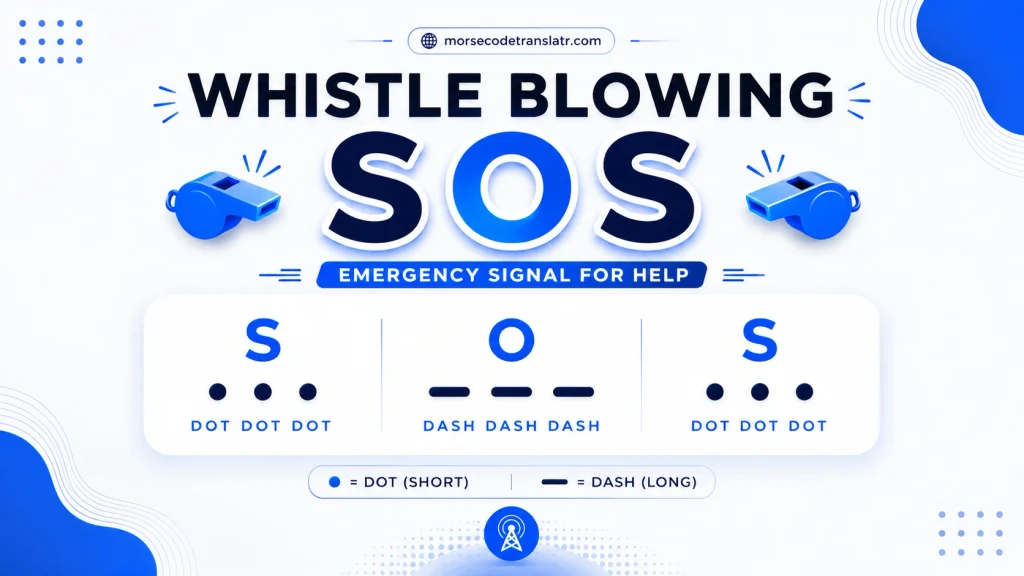
Whistle Blowing
There is another scenario to utilize the SOS signals that involves blowing a whistle. There are certain parts of the country or remote areas where typical devices refrain from providing signals; the SOS signals are the best method to use in that particular situation or while exploring remote areas.
Final Words
The SOS is a globally accepted signal transmitter available in the form of three dots, three dashes, and three dots. The SOS is not limited to only Morse Code since it was connected with CQD earlier, but a common pattern that is considered now is SOS. There are diverse ways to send distress messages other than the direct method, such as whistling and flashlight signal transmission. Important Note: The SOS signals are not meant to be sent for fun or any unnecessary activity; rather, it was designed to be used specifically in emergencies.
Frequently Asked Questions
The SOS is the international Morse code distress signal, SOS sent in Morse code as three short signals, three long signals, and three short signals (...---...). SOS signals are sent to indicate emergencies.
In Morse code, SOS is written as (... - - - ...) three dots, three dashes, and then three dots again. These are easy Morse code signals to recognize.
No, SOS does not officially stand for “Save Our Souls” or “Save Our Ship”. These three letters are used because they are the international Morse code distress signal and are simple to remember in Morse code.
Besides the radio, you can send an SOS through a flashlight or light signals, or by vibration. An easier method is to use a translator and type SOS and save it for sending.